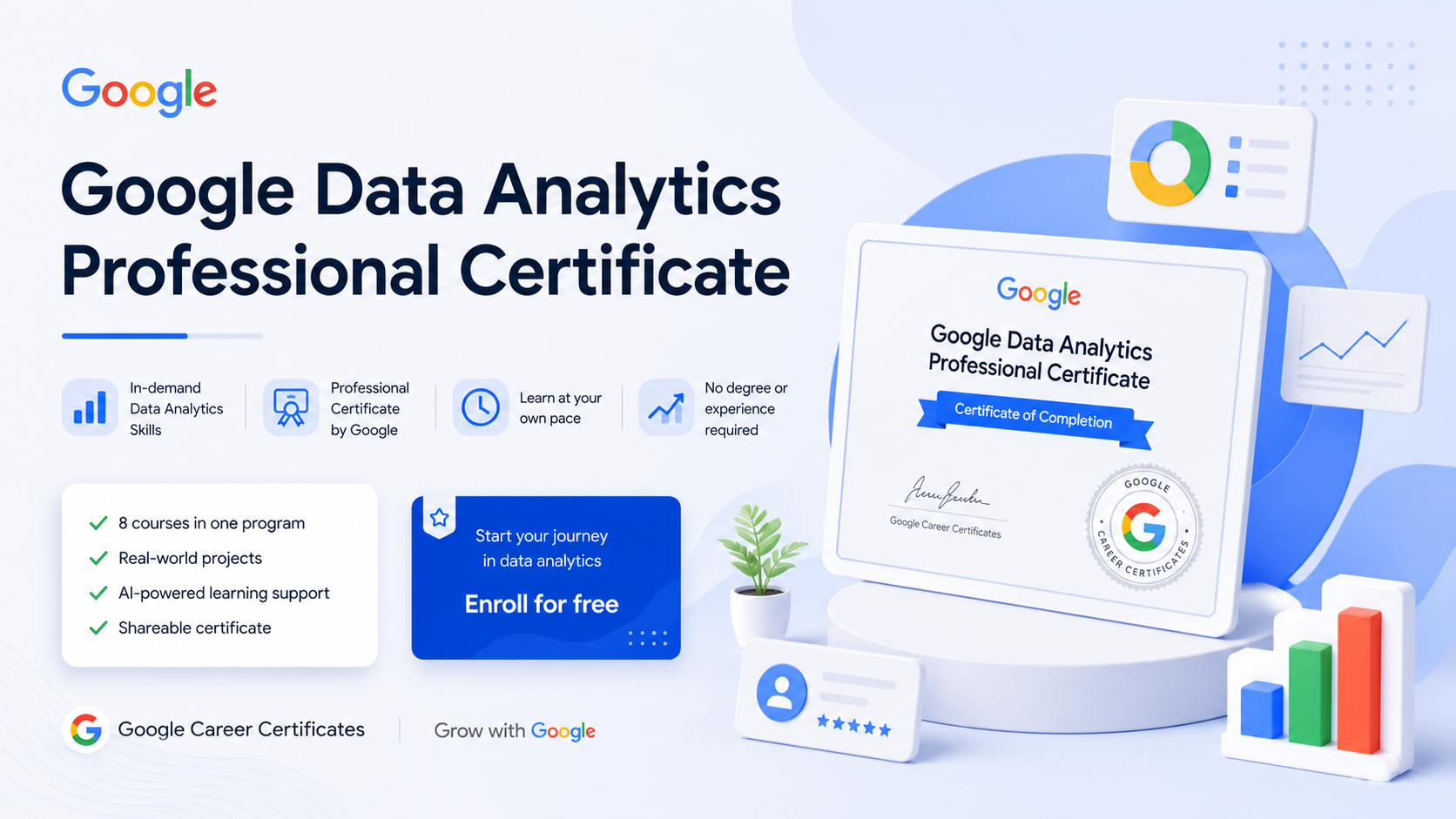
The Google Data Analytics Professional Certificate has become the internet’s default first step into a data career. More than 3.6 million learners have enrolled through Coursera, and opinions on it split into two loud camps: those who credit it with launching their careers, and those who dismiss it as an expensive PDF. Before you spend your money or your time, you deserve a straight answer to the two questions everyone asks: Is it worth it? And can it actually get you hired?
This review answers both without the affiliate-page cheerleading. It draws on Google’s own 2026 program data, independent salary research, and the patterns that show up again and again in learner discussions. It also corrects a problem that plagues nearly every article ranking for this topic: they describe a version of the certificate that no longer exists. Google overhauled the program in January 2026. It now runs nine courses, teaches Python rather than R, folds AI-assisted analysis into the curriculum, and adds a standalone course on job searching. Any review still claiming “eight courses, R programming, no Python” is describing the retired syllabus.
You’ll also find several practical tools here that the typical review skips: a four-layer Employability Stack, a job-readiness audit checklist, cost and ROI tables, a QUEST portfolio framework, and a short decision tree to settle whether enrolling makes sense for you at all.
How this was verified: Every price, course name, and statistic below was checked against the official Coursera program page and Grow with Google on July 13, 2026. Coursera adjusts pricing, promotions, regional availability, and course content whenever it likes, so double-check the live program page before paying.
Should You Get the Google Data Analytics Certificate?
Yes, if you’re a beginner looking for a structured, low-cost entry into analytics. At roughly $49 a month (usually under $300 all-in), it delivers hands-on training in tools employers actually use: spreadsheets, SQL, Tableau, and, since 2026, Python. It also carries real name recognition, backed by Google’s consortium of more than 150 hiring companies. What it will not do is land you a job by itself. The graduates who convert it into offers add a portfolio, extra SQL repetition, and interview practice on top.
Boiled down to one sentence: the certificate hands you the toolkit and the vocabulary; the portfolio and the interviews are what get you paid.
Enroll if you:
- Are starting from zero and want an ordered curriculum instead of a random stack of YouTube tutorials.
- Want a cheap way to find out whether data work suits you before spending on a bootcamp or degree.
- Want guided, practical reps with spreadsheets, SQL, Tableau, and Python.
- Are willing to build your own projects once the courses end.
- Can move quickly enough to keep the subscription bill small.
- Accept that a credential supports a job hunt rather than replacing one.
Skip it if you:
- Already work comfortably in SQL, Python, spreadsheets, and Tableau.
- Need machine learning, serious statistics, Power BI, or data engineering, since this program covers none of them in depth.
- Are counting on Google to hand you a position.
- Want an exam-based professional certification rather than a coursework certificate.
- Need college credit that your school has guaranteed in writing.
- Care more about posting a badge than acquiring the skills behind it.
Bottom line: among the cheapest good first moves in a data career, as long as you treat it as the opening step of a longer plan rather than the plan itself.
The Certificate at a Glance
| Feature | Details (checked July 2026) |
|---|---|
| Created by | |
| Hosted on | Coursera |
| Curriculum | Nine courses, capstone included |
| Level | Beginner; no degree or experience needed |
| Delivery | 100% online, self-paced |
| Programming language | Python (R retired in the January 2026 refresh) |
| Core tools | Spreadsheets, SQL, Tableau, Python, presentation software |
| AI coverage | AI-assisted cleaning, visualization, and job-search training |
| Official duration estimate | Under 6 months at under 10 hours/week |
| Total instruction | 180+ hours per the overview (individual course cards sum to ~152) |
| Capstone | End-to-end analytics case study |
| US/Canada price | $49/month after a 7-day trial (where eligible) |
| Typical maximum spend | Under $300 pre-tax across six months |
| In Coursera Plus? | Yes |
| College credit | ACE-recommended for as many as 12 US credits (7 ECTS) |
| Hiring network | 150+ US employers, with separate consortiums in some countries |
| Learner rating | About 4.8/5 on Coursera; 3.6M+ enrollments |
| Guaranteed job? | No |
The 2026 Overhaul (and Why Most Reviews Got Left Behind)
Start here if you’ve read older reviews, because this section settles the “isn’t it outdated?” argument. The certificate you can enroll in today differs in real ways from the one most blogs still describe.
Python replaced R. The program now includes a purpose-built course, Introduction to Data Analysis Using Python, in place of the old R module. For years the loudest complaint was “job listings want Python, so why is Google teaching R?” That complaint is now moot. Coursera’s own FAQ confirms R has been dropped from the main track.
AI is woven into the coursework. Learners practice using AI to speed up data cleaning, structure messy files, and brainstorm visualizations, which mirrors how working analysts operate in 2026. Google has stated that AI training now runs through all of its Career Certificates.
A full job-search course joined the lineup. Accelerate Your Job Search with AI walks through résumés, portfolios, applications, and interview prep using tools like Gemini and NotebookLM.
Eight courses became nine.
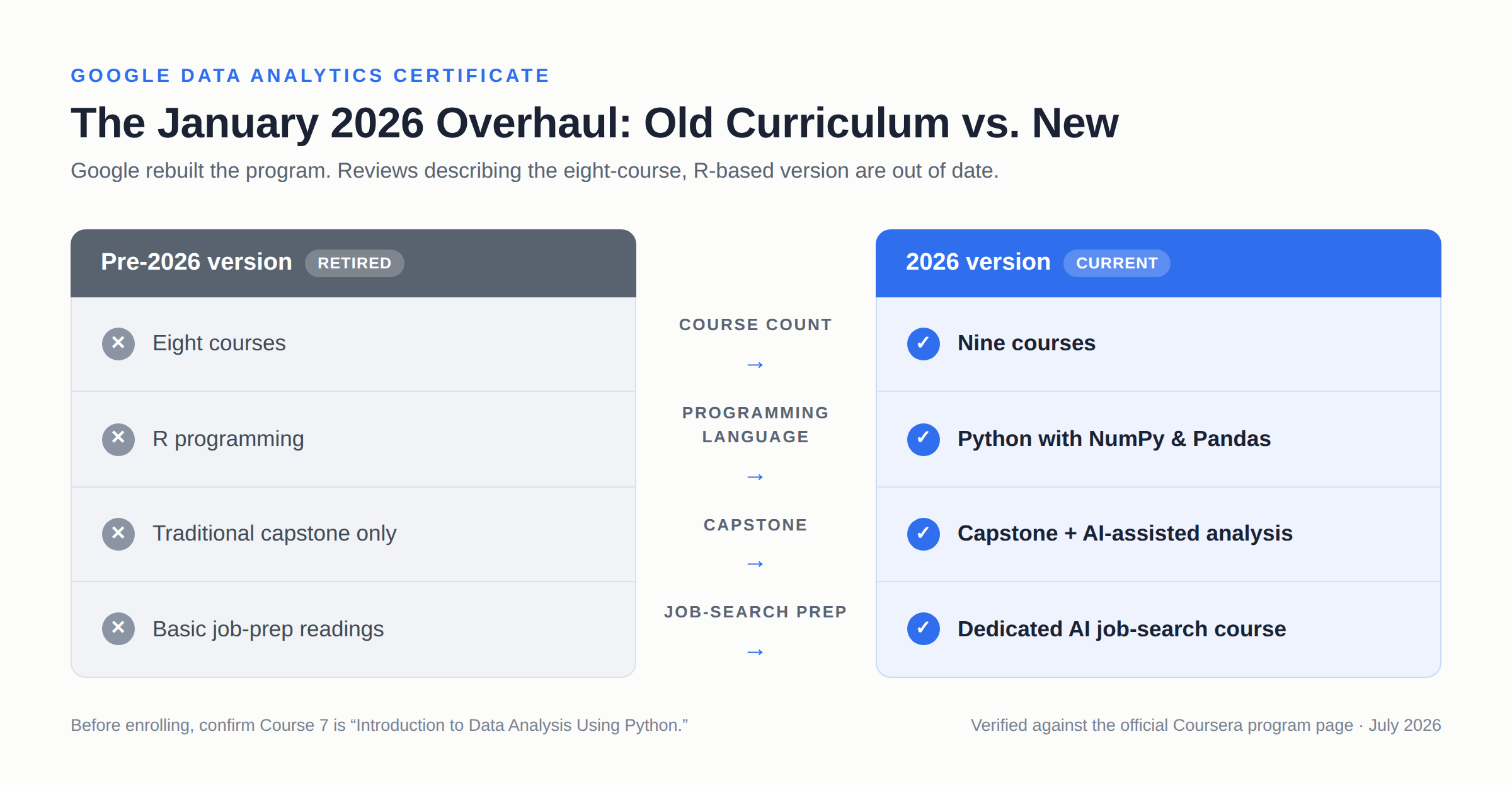
Watch for leftover R references. The migration isn’t perfectly clean. A few regional Google pages and scraps of capstone copy still mention R or list eight courses, and some competing reviews wrongly claim the program covers “both R and Python.” The live Coursera syllabus is Python-only. Before you pay, open Course 7 and verify it reads Introduction to Data Analysis Using Python, not the discontinued R course. Learners who were mid-program in the R version got a limited completion window once new sign-ups for that track closed in late January 2026.
So if your one hesitation was “it teaches an outdated language,” that objection is dead. The concern that survives, and deserves your attention, is depth. The rest of this review deals with it head-on.
What Exactly Is the Google Data Analytics Professional Certificate?
It’s a self-paced online program that trains you for the day-to-day work of a junior or associate data analyst. Everything is organized around the six-phase workflow Google calls Ask, Prepare, Process, Analyze, Share, Act:
- Frame the business problem and ask questions worth answering.
- Gather and organize the relevant data.
- Clean it and check its integrity.
- Analyze it to answer the original question.
- Turn the findings into visuals and a clear story.
- Deliver a recommendation, then complete a capstone case study you can show off.
Google employees built the curriculum, which mixes video lessons, readings, quizzes, hands-on labs, and graded practice work. Coursera markets it as preparation for entry-level analyst roles, not for data science or advanced analytics, and that framing is accurate.
Inside the Program: All 9 Courses
| # | Course | What you build | Primary tools | Est. hours |
|---|---|---|---|---|
| 1 | Foundations: Data, Data, Everywhere | How analysts think, the data life cycle, core vocabulary, ethics | Concepts | 13 |
| 2 | Ask Questions to Make Data-Driven Decisions | Structured problem framing, working with stakeholders | Spreadsheets | 15 |
| 3 | Prepare Data for Exploration | Bias, data types, databases, first SQL queries | SQL, spreadsheets | 19 |
| 4 | Process Data from Dirty to Clean | Cleaning workflows, integrity checks, validating, documenting | Spreadsheets, SQL | 16 |
| 5 | Analyze Data to Answer Questions | Formulas, pivot tables, joins, aggregation, filtering | Spreadsheets, SQL | 26 |
| 6 | Share Data Through the Art of Visualization | Dashboard design, storytelling with data, presenting | Tableau | 19 |
| 7 | Introduction to Data Analysis Using Python | Python basics, NumPy, Pandas, cleaning and analysis | Python | 27 |
| 8 | Google Data Analytics Capstone: Complete a Case Study | A start-to-finish portfolio project | Your pick | 11 |
| 9 | Accelerate Your Job Search with AI | Applications, résumé, portfolio, interview prep | AI career tools | 6 |
Three of these deserve a closer look:
- Course 5 is the heaviest non-programming course and arguably the most job-relevant one: pivot tables, joins, aggregations, and SQL queries are the bread and butter of real analyst work.
- Course 7 is the marquee 2026 addition. Python shows up everywhere in analytics, automation, and data science, but understand that 27 hours is an introduction, not mastery. Budget time to keep coding after you finish.
- Course 8, the capstone, exists to seed your portfolio. Whatever you do, don’t ship the same bike-share or fitness-tracker case study as the thousands of graduates before you. Run the same process on a dataset nobody else is using.
Here’s the honest framing: the program gives you working literacy across the core analyst toolkit plus a repeatable method for attacking a business question. It does not give you interview-grade fluency in any one tool. You’ll leave able to use SQL, which is different from sailing through a tough SQL screen. Closing that distance is exactly what the Employability Stack below is for.
The Skills You Walk Away With
Spreadsheets. Formulas, functions, pivot tables, sorting, filtering, cleanup, and organization. Don’t dismiss this one; plenty of entry-level analyst work still happens in Excel or Google Sheets even at companies with mature databases and BI stacks.
SQL. The fundamentals: selecting, filtering, string cleanup, joins, calculations, and querying relational databases. SQL is probably the single most valuable skill in the program, and also the one where the coursework stops well short of interview depth. On your own time, drill CTEs, subqueries, window functions, date handling, CASE logic, multi-table joins, and debugging queries that return wrong answers.
Tableau. Building charts, dashboards, and data stories. The course pushes you to explain what a chart means and which decision it should drive, rather than just making something pretty.
Python with NumPy and Pandas. By the end you can load, clean, and analyze a dataset in Python at a beginner level. One intro course won’t cover automation, statistics, machine learning, or serious programming, and it doesn’t pretend to.
Analytical thinking. Defining problems, asking sharper questions, judging data quality, catching bias, and tying analysis back to business decisions. Tools change; these habits carry over.
Communication. Converting analysis into dashboards, presentations, recommendations, and stakeholder updates. This is the skill beginners undervalue most, and the one hiring managers notice first.
AI-assisted work. Using AI to draft formulas, suggest cleaning steps, propose chart ideas, and polish applications, while staying responsible for verifying everything it produces. AI output you can’t check is a liability, not a shortcut.
Where the Certificate Runs Shallow?
The program trades depth for breadth, and entry-level hiring often punishes that trade. Here’s what the coursework introduces next to what you’ll still have to develop on your own.
| The certificate covers | You still need to build |
|---|---|
| Spreadsheet fundamentals | Advanced SQL: window functions, complex joins, optimization |
| Introductory SQL | Power BI (the program only teaches Tableau) |
| Tableau dashboards | Statistics: hypothesis tests, regression, A/B testing |
| Beginner Python (NumPy, Pandas) | Deeper Python: APIs, error handling, reproducible pipelines |
| Data cleaning | Data engineering and modeling: ETL, pipelines, warehouse design |
| Data storytelling | Handling real workplace mess: bad data, conflicting stakeholders |
For several of these gaps, a specific next step already exists:
- Statistics and machine learning: the Google Advanced Data Analytics Professional Certificate.
- ETL, warehousing, and data modeling: the Google Business Intelligence Certificate.
- Power BI: Microsoft’s Power BI Data Analyst Professional Certificate, which also feeds into the PL-300 exam.
One gap has no course fix anywhere: the mess of actual jobs. Training datasets are clean by design. Real projects come with undocumented tables, stakeholders who want contradictory things, permissions you don’t have, deadlines that move, and three departments calculating “revenue” three different ways. The certificate teaches you the process. Only experience teaches the judgment.
How Hard Is It?
Not very, and that cuts both ways. Google asks for no degree, no tool experience, and nothing beyond high-school math and genuine curiosity. Most learners cruise through Courses 1 through 4 and then feel the difficulty rise across Courses 5 through 8, where SQL, Python, and the capstone live. That harder stretch is where the value is.
The warning that comes up constantly on Reddit and in reviews: easy material creates false confidence. Clearing a guided SQL quiz feels like competence. Facing a novel SQL problem in a timed interview is a different sport. When the coursework feels easy, read that as a cue to add outside practice, not as evidence you’re finished.
A quick self-test for real readiness
Before a skill goes on your résumé, confirm you can do it without peeking at the lessons:
- Load a dataset you’ve never seen and find its missing and duplicated values.
- Write a working SQL join from memory.
- Build a Tableau dashboard on a fresh dataset, no template.
- Clean and analyze a file in Pandas starting from a blank notebook.
- Present three actionable recommendations and name the limitations of your own analysis.
Quizzes prove you finished a course. New problems prove the skill transfers.
How Long Will It Take You??
Coursera’s official line is under six months at less than 10 hours a week, with the program described as 180+ hours of instruction and assessment. Your actual timeline depends almost entirely on your hours per week.
| Weekly study time | Rough timeline (at 180 hours) |
|---|---|
| 5 hours | ~36 weeks |
| 8 hours | ~23 weeks |
| 10 hours | ~18 weeks |
| 15 hours | ~12 weeks |
| 20 hours | ~9 weeks |
A small discrepancy worth knowing: the nine course cards currently add up to about 152 hours, while the overview page says 180+. The gap likely covers assessments, review, and project time. For planning, 150 to 200 hours is a sensible budget.
Could you finish in a month? Someone with prior exposure can, mostly by speeding through familiar videos. A true beginner would need around 45 hours a week, which produces a certificate and very little retention.
Could you finish inside the 7-day trial? For most beginners, no. Coursera also tends to withhold any certificate you complete mid-trial until the trial period lapses and your first charge goes through.
What It Costs (and the ROI Arithmetic Most Reviews Skip)
There’s no flat fee. The certificate runs on a Coursera subscription at $49/month in the US and Canada, following a 7-day free trial, which means your pace sets your price.
| Time to finish | Subscription total (pre-tax) |
|---|---|
| 1 month (or within the trial) | $0–$49 |
| 2 months | $98 |
| 3 months | $147 |
| 4 months | $196 |
| 5 months | $245 |
| 6 months (the standard pace) | $294 |
| 8 months (after drifting) | $392 |
Three money facts the checkout page won’t emphasize:
- Speed is a discount. A committed full-time learner can wrap the program in 4 to 6 weeks and pay for a single month, or pay nothing by finishing inside the trial and canceling before it renews.
- Financial aid can zero it out. Coursera Financial Aid is applied for from the course page and takes about two weeks to process. Important: if you begin the free trial while an aid request is still under review, the request gets voided. For multi-course programs, you may need to apply course by course.
- You might not have to pay at all. Plenty of US libraries, employers, community colleges, and state workforce programs sponsor Google Career Certificate access or offer scholarships. Ask before you subscribe.
Included in Coursera Plus? Yes. The standalone $49/month route is cheaper if this is the only program you want and you move fast. Coursera Plus wins if you intend to stack it with Google Advanced Data Analytics, Google Business Intelligence, IBM Data Analyst, or Microsoft Power BI.
What about free alternatives? Kaggle Learn, freeCodeCamp, and Google’s own free materials cover much of the same SQL, Python, and spreadsheet ground for nothing. What they lack is the fixed sequence, graded work, the employer consortium, and a credential recruiters recognize. A common and sensible pattern: sample the free stuff to confirm your interest, then pay for the structure and the certificate.
Running the ROI numbers
Google quotes a median entry-level salary of roughly $97,000 in data analytics and more than 270,000 open US roles. Even after discounting that median hard (career changers frequently see first offers of $55,000 to $80,000 depending on market), you’re weighing a sub-$300 cost against a five-figure salary jump. If the credential contributes to landing a role, it repays itself within the first paycheck. The word doing all the work in that sentence is if, and the if is decided by your portfolio, not the certificate.
Will billing stop on its own? Coursera says Professional Certificate subscriptions generally end when you earn the certificate, but check your billing anyway after you finish. Canceling never revokes certificates you’ve already earned; incomplete coursework simply unlocks again if you resubscribe later.
The Evidence-Based Verdict on Whether It’s Worth It
Most pages ranking for this question are affiliate content that answers “absolutely!” and moves straight to the signup link. Here’s the version that takes your money seriously.
Google’s headline numbers, read carefully
- 75% of graduates say their career improved within six months, counting new jobs, promotions, and raises.
- A field median salary near $97,000 for entry-level data analytics roles.
- 270,000+ open US positions.
All three are real figures. All three need context:
- That 75% comes from a self-selected 2022 survey of US graduates, and survey respondents lean positive. “Positive outcome” also counts raises and promotions earned by people who already had jobs, not just fresh analytics hires.
- The $97,000 is the median for the occupation, not the audited earnings of certificate holders. It describes what analyst roles pay, not what your first offer will say.
- The job market has moved since 2022, and Google reported over one million Career Certificate graduates worldwide (350,000+ in the US) as of May 2025. A credential held by a million people is not a differentiator by itself.
None of that makes it a bad purchase. It makes it an unusually cheap foundation, not a salary machine.
What the independent research shows
Stanford’s Susan Athey and Emil Palikot studied this question in The Value of Non-Traditional Credentials in the Labor Market, an experiment covering more than 800,000 Coursera learners. When learners were nudged to share their completed micro-credentials, sharing rose by 17 percentage points. Reported new employment ran 6% higher in that group, and reports of a job connected to the credential ran 8% higher. Most participants came from developing countries and were spread across business and tech courses, so this isn’t a direct test of this specific program.
The takeaway isn’t “post your certificate and get hired.” It’s that a credential works harder when it’s visible and sits next to proof of skill.
Where it earns its price
You’re new and want an ordered path instead of tutorial chaos. You want a cheap experiment to test whether data work fits you. You want a name employers recognize on your résumé and LinkedIn. You want a structured capstone to launch your portfolio.
Where it disappoints
Depth (you get introductions, not fluency), ubiquity (with millions of holders, the badge alone blends in), and the “paper equals job” assumption. Scan the regret posts online and the pattern is consistent: people rarely regret the money, they regret expecting the certificate to generate interviews on its own.
Verdict: worth it as move one of a three- or four-move plan. Accept that before you enroll and it’s one of the best values in tech education.
Will This Certificate Alone Get You Hired?
Honest answer: alone, rarely. Combined with a portfolio and deliberate practice, routinely.
What it genuinely does for your search:
- Tells recruiters and applicant-tracking systems that you have baseline literacy and follow-through.
- Opens direct applications to the 150+ companies in Google’s Career Certificates Employer Consortium, a list that includes Deloitte, Target, Verizon, and Google, with parallel consortiums in Canada, India, Singapore, and Indonesia.
- Comes with career support such as coaching, interview simulations, and résumé tools.
What it can’t do:
- Demonstrate that you can crack a business problem you’ve never seen.
- Stand in for a portfolio; hiring managers judge your projects, not your course list.
- Pass a technical SQL screen or case interview on your behalf.
The consortium gets misread constantly, so let’s be precise: it’s an application channel, not a hiring promise. Member companies interview certificate graduates exactly like everyone else. Google doesn’t screen your résumé for them, and no jobs are held in reserve.
The path that reliably works looks like this: certificate → SQL plus one BI tool drilled until interviews feel routine → two or three business-grounded portfolio projects → steady networking and applications. Compare that with the pattern behind most “200 applications, zero replies” posts: certificate alone, no portfolio, résumé blasted everywhere.
An Original Framework: The 4-Layer Employability Stack
“Build a portfolio” is where most advice stops. Here’s an actual operating plan for converting the certificate into an offer. Each layer amplifies the one beneath it.
Layer 1: Credential (the base). The certificate itself. It proves you completed structured training. Necessary, nowhere near sufficient. Time: however long the program takes you.
Layer 2: Depth (the separator). Choose one BI tool (Tableau or Power BI) plus SQL, and push both past beginner level: at least 50 SQL problems on a practice platform, plus one dashboard rebuilt entirely from scratch with no instructions open. This is the layer that survives contact with a technical screen. Time: 3 to 5 focused weeks.
Layer 3: Proof (the portfolio). Two or three projects, each answering a genuine business question start to finish, published somewhere a recruiter can reach in one click (GitHub, Tableau Public, or a simple personal site). Your capstone counts as one of the three. Time: 2 to 4 weeks. The portfolio guide below covers the details.
Layer 4: Visibility (the amplifier). A focused résumé that names your tools, a LinkedIn Licenses & Certifications entry with the credential link, a short write-up on each project, and regular networking. This layer converts finished work into actual interviews. Time: ongoing.
The rule worth memorizing: one certificate plus three shipped projects beats five certificates plus zero projects, without exception. Recruiters pay for demonstrated work, not completion badges.
The Portfolio Playbook
Treat the capstone as your portfolio’s first entry, never its last. Two things make each project land with recruiters: the QUEST framework for structure, and three battle-tested project types for substance.
Structure every project with QUEST
- Q, Question. One sentence stating the business problem. Weak: “I explored a sales dataset.” Strong: “Leadership wants to know why repeat purchases dropped in the second half of the year.”
- U, Underlying data. Document your source, the variables, missing values, duplicates, potential bias, limitations, and every cleaning decision you made.
- E, Exploration. Show analysis that goes beyond a tutorial walkthrough: your SQL queries, a Python notebook, segmentation, trend work.
- S, Storytelling visuals. Charts that answer the stated question directly, not a dashboard crammed with unrelated widgets.
- T, Takeaway. End with the core finding, a recommended action, the expected business impact, the risks, and what you’d analyze next.
Three projects that generate interviews
Project 1: a SQL business deep-dive (proves technical depth). Pick an e-commerce, subscription, restaurant, or transit dataset. Show joins, aggregations, date logic, CASE calculations, CTEs, and window functions. Deliverable: a commented query file and a concise findings memo.
Project 2: a Python cleaning and exploration notebook (proves rigor). Choose a genuinely messy dataset and demonstrate importing, type conversion, missing-value handling, deduplication, outlier investigation, grouped analysis, and code someone else could rerun. Deliverable: a published notebook.
Project 3: a Tableau or Power BI dashboard (proves communication). Design for a named audience: an executive sales view, a retention monitor, an operations scorecard, or public-health trends. Deliverable: a live, interactive dashboard with a one-page recommendation memo, e.g., “target retention efforts at month-to-month customers with heavy support-ticket volume.”
The six-part template that finishes any project
- The business question, in one sentence.
- Data source and cleaning steps, documented without flattery.
- The analysis, with real queries or code on display.
- One visualization or dashboard that carries the argument.
- A recommendation, phrased as you’d say it to a manager.
- A brief “what I’d do next,” showing you understand your own limits.
The Job-Readiness Audit
Run this before you start applying. It measures whether you can operate beyond guided exercises. Checking most boxes means you’re actually ready.
Spreadsheets
- ☐ Apply lookup functions and conditional formulas
- ☐ Clean inconsistent, messy data
- ☐ Build pivot tables and charts that serve a purpose
- ☐ Explain the logic behind your calculations
SQL
- ☐ Filter, aggregate, and join across multiple tables
- ☐ Write subqueries and common table expressions
- ☐ Use window functions and handle date logic
- ☐ Diagnose a query returning wrong results
Python
- ☐ Load and inspect data with Pandas and NumPy
- ☐ Handle missing values and duplicates
- ☐ Group, summarize, and visualize
- ☐ Walk someone through your code
Visualization
- ☐ Pick the right chart type and assemble a dashboard
- ☐ Avoid misleading axes; label accessibly
- ☐ Tie every visual to a recommendation
Business analysis
- ☐ Convert a vague request into a measurable question
- ☐ Name the relevant metrics, assumptions, and limitations
- ☐ Brief a non-technical stakeholder clearly
Job search
- ☐ Get three projects of your own published
- ☐ Rework your résumé and rehearse five project stories
- ☐ Practice interview-style SQL and apply broadly across analyst titles
Which Jobs to Target?
Coursera pitches the certificate at roles like junior or associate data analyst, operations analyst, finance analyst, business intelligence analyst, healthcare analyst, and HR or payroll analyst. Titles vary enormously between companies, so widen your searches: reporting analyst, marketing analyst, sales analyst, workforce analyst, product operations analyst, data quality analyst, customer insights analyst, supply chain analyst, and revenue operations analyst all describe overlapping work.
Your previous career is an asset, not baggage. Retail experience translates into sales and inventory analysis. Teaching translates into education data. Healthcare administration translates into patient-flow analysis. Marketing translates into campaign measurement, and finance into reporting and forecasting. Domain knowledge is the thing that distinguishes you from every other graduate holding the same PDF.
Should You Enroll? A One-Minute Decision Tree
- Are you already comfortable with intermediate SQL, working Python, and building dashboards unassisted?
- Yes: Skip this one. Go directly to Google Advanced Data Analytics or another Python-heavy program.
- No: Next question.
- Do you specifically need statistics, machine learning, data engineering, or an exam-based certification?
- Yes: Pick a specialized program instead (Google Business Intelligence, Google Advanced Data Analytics, or Power BI with PL-300), or take it after this one.
- No: Next question.
- Will you commit to building original projects and practicing SQL after the courses end?
- No: Think twice. On its own, the certificate rarely produces interviews.
- Yes: Enroll. You’re exactly who this program serves. Set an aggressive schedule to control cost and start the 12-week roadmap.
The 12-Week Roadmap: Finish With a Portfolio, Not Just a PDF
Plan on 15 to 20 hours a week. This schedule compresses the certificate and stacks the outside practice that actually converts into offers.
Weeks 1–3: Courses 1–4 (foundations). Complete every hands-on activity, not only the quizzes. Redo exercises with the instructions closed, and keep a running file of formulas and queries you’ll reuse.
Weeks 4–7: Courses 5–7 (SQL, visualization, Python). Alongside the coursework, open an account on a free SQL practice site and solve a few problems every day. Speed through the video-heavy stretches; slow down hard when SQL and Python arrive.
Weeks 8–9: Course 8, the capstone. Treat it as a genuine portfolio piece. Use the QUEST structure and a dataset other graduates aren’t using. Don’t treat it as a box to tick.
Weeks 10–11: Deepen and build. Solve 30 to 50 fresh SQL problems (joins, CTEs, dates, CASE logic, window functions). Produce one Python notebook and one Tableau or Power BI dashboard, both from raw data.
Week 12: Course 9, then launch. Publish everything (GitHub, Tableau Public, or a simple site), refresh your LinkedIn and résumé, script five stories about your projects, set up an application tracker, and start applying. Apply before you feel completely ready, because nobody ever does.
Need a gentler pace? The same sequence works over 16 weeks at 10 to 12 hours weekly. Just hold one line: a 3-month program must not become an 8-month one. Every extra month costs another $49 and, worse, momentum.
The Mistakes Graduates Regret Most (Straight From Reddit and Reviews)
- Stopping at the certificate. It’s step one. Nearly every “I applied everywhere and heard nothing” story is missing a portfolio.
- Practicing SQL only inside the course. Guided exercises don’t simulate a technical screen. Outside reps do.
- Stacking certificates instead of shipping projects. A third project moves the needle; a third certificate almost never does.
- Publishing nothing. Work a recruiter can’t open within ten seconds may as well not exist.
- Neglecting communication. Analysts get hired to translate findings for people who aren’t analysts, so end every project with a recommendation in plain language.
- Letting it drag. Stalled momentum is the number one killer of self-paced programs.
How It Stacks Up Against the Alternatives
| Program | Best suited for | Level | Core tools | Key distinction |
|---|---|---|---|---|
| Google Data Analytics | Complete beginners | Entry | Spreadsheets, SQL, Tableau, Python | The widest on-ramp; the default starting point |
| Google Advanced Data Analytics | Graduates of the first certificate | Intermediate | Python, statistics, regression, ML | Heavier on Python and stats; the natural sequel |
| Google Business Intelligence | Future BI analysts | Advanced | SQL, Tableau, ETL, warehousing | Centers on data modeling and reporting pipelines |
| IBM Data Analyst | Beginners wanting Python sooner | Entry | Python, SQL, Excel, Cognos | Heavier Python plus IBM tooling; grants a badge |
| Microsoft Power BI Data Analyst | Power BI-centric roles | Entry–Intermediate | Power BI, DAX | Prepares you for the PL-300 exam |
Choosing between them:
- Brand new to the field? Google Data Analytics first.
- Already technical or past the basics? Jump to Google Advanced Data Analytics or another Python-forward program.
- Drawn to reporting systems and dashboards? Add Google Business Intelligence.
- Local postings mention Power BI more than Tableau? Add Microsoft’s certificate.
A common and effective sequence is Google Data Analytics followed by Advanced Data Analytics, using the two as a beginner-through-intermediate track. Note that no option on this list spares you from building independent projects.
Google vs. IBM, specifically: IBM runs 11 courses to Google’s 9, leans harder on tooling (Excel, Jupyter, Cognos), issues a digital badge from IBM, and usually takes around four months. Pick Google for its clear analysis framework, stakeholder communication focus, Tableau, and brand weight. Pick IBM for more Python time, Jupyter notebooks, and multiple built-in portfolio projects.
Accreditation, College Credit, and Certificate vs. Certification
Is it accredited? It isn’t a degree, diploma, or license. It does carry a recommendation from the American Council on Education (ACE) for as many as 12 US college credits (7 ECTS for European institutions). A recommendation isn’t a promise: each institution independently decides whether to accept the credits, how many to grant, and whether they count toward a major or only as electives. Because the 2026 refresh swapped R for Python, check with your school that its transfer policy covers the exact version you completed, and get the answer in writing before enrolling purely for credit.
Certificate or certification? This is a Professional Certificate: you earn it by finishing Coursera coursework and passing its assessments. That’s different from an independent, exam-based certification such as Microsoft’s Power BI Data Analyst Associate, CompTIA Data+, Certified Analytics Professional, or Tableau Certified Data Analyst, each of which involves sitting a separate standardized exam.
On your résumé, the correct line is “Google Data Analytics Professional Certificate.” Never write “Google-Certified Data Analyst,” which falsely suggests Google examined and licensed your professional competence.
Does it expire? No. Certificates you’ve earned remain attached to your Coursera account even after you cancel, and the verification link stays live. Your skills are another matter. SQL, Python libraries, BI tools, and AI workflows all age, and a years-old certificate persuades far more when it sits beside recent projects.
Putting It on Your Résumé and LinkedIn
On the résumé, write the credential name exactly and back it with evidence.
The minimum version:
Google Data Analytics Professional Certificate | Google / Coursera Earned July 2026 · Tools: SQL, Python, Tableau, spreadsheets, data cleaning & visualization · Verify: [credential link]
The stronger, project-anchored version:
Google Data Analytics Professional Certificate | Google / Coursera Earned through 180+ hours of coursework in SQL, Python, Tableau, spreadsheets, and data storytelling. Followed it with a self-directed retention analysis of 80,000 customer records, delivering three recommendations through an interactive dashboard.
It belongs in a Certifications section (or Professional Development / Technical Education), never among your degrees.
On LinkedIn, use the Certifications section: credential name, Google as the issuer, completion date, credential link, associated skills, and a link to your portfolio. Don’t just post the certificate image; add a few lines about what you built with it. The Stanford research above suggests that making a micro-credential visible measurably improves its signal, particularly when you have few other professional markers.
Pros and Cons
Strengths: genuinely beginner-friendly with zero prerequisites; fully online and self-paced; inexpensive relative to alternatives; a coherent, ordered learning path; up-to-date Python instruction; solid SQL and spreadsheet foundations; Tableau training; extensive data-cleaning practice; consistent emphasis on business context and stakeholders; a capstone built for your portfolio; integrated AI-assisted analytics; a standalone job-search course; college-credit recommendations from ACE (and ECTS equivalents); and a Google-branded credential employers recognize.
Weaknesses: completion alone rarely equals job readiness; SQL and Python stay introductory; no Power BI; thin statistics and no machine learning; no real data engineering; capstone submissions blur together across thousands of learners; costs climb when progress stalls; the employer consortium is not a placement service; scattered official pages still show stale R-era details; and the much-quoted 75% outcome figure rests on a self-reported 2022 survey.
What Actual Learners Report?
Read enough threads and reviews and a stable pattern emerges.
The praise: logical sequencing, explanations that assume nothing, exposure to multiple tools, the focus on process over button-clicking, flexible pacing, and the motivational pull of a structured program. Some graduates credit it with revealing their blind spots, sharpening interview prep, or enabling a switch into analytics, always in combination with additional practice and portfolio work.
The complaints: SQL that stays too shallow, limited Tableau coverage, the absence of Power BI, feeling stranded when building an independent portfolio, and silence from recruiters after posting the certificate alone. One Reddit commenter described it as a useful framework that demands deeper follow-up study; another observed that hiring managers care mostly about what you build afterward. Anecdotes, yes, but their sheer consistency says something about the distance between guided coursework and independent analysis.
Verdict
In 2026 the Google Data Analytics Professional Certificate is still one of the strongest entry points into the field. Structure, accessibility, low cost, and breadth are its assets, and the Python refresh brings the curriculum in line with where analytics and data science tooling actually sit. Its enduring weakness is the space between finishing courses and performing professionally; no single program makes anyone fluent in SQL, Python, Tableau, spreadsheets, stakeholder communication, and business analysis all at once.
The five things to remember:
- It’s an inexpensive, beginner-friendly foundation (under $300), not an employment guarantee.
- The 2026 edition is a real upgrade: nine courses, Python instead of R, AI-assisted analysis, and a job-search course. Disregard reviews of the old eight-course R program.
- The portfolio decides your outcome. The certificate gets you a look; two or three genuine projects get you the offer.
- Treat the statistics with adult skepticism. The 75% outcome rate is self-reported, and the $97,000 figure is an occupational median, not a promise.
- Move fast and publish. Speed saves money and momentum, and unpublished work is invisible.
The whole strategy in a single line: the certificate, then SQL and one BI tool sharpened to interview level, then three public projects, all explained in plain language. Execute that and this is one of the best-value opening moves in a data career. Rely on the certificate by itself and you’ll join the crowd wondering why nobody called back.
Frequently Asked Questions
Is the Google Data Analytics Professional Certificate worth it in 2026? For beginners wanting an affordable, organized foundation, yes. It teaches real tools, employers recognize it, and it costs under $300. It only disappoints when treated as a shortcut to employment; graduates who land roles back it up with a portfolio and additional SQL practice.
Did Python really replace R? Yes. Since January 2026 the program teaches Python via Introduction to Data Analysis Using Python, and R is gone from the main curriculum. Some regional pages and stale reviews (including ones claiming it covers “both languages”) still describe the old version.
How many courses are there, and is there a capstone? Nine courses, capstone included. The capstone doubles as the seed of your portfolio. The previous edition had eight courses.
How long does it take? Coursera estimates less than six months at under 10 hours weekly. Realistically budget 150 to 200 hours total; full-time learners often finish in 4 to 8 weeks.
What does it cost? It’s a $49 monthly Coursera subscription that begins after a 7-day free trial, so most learners spend under $300 depending on pace. Financial aid or sponsorship from an employer, school, or library can cut that to zero.
Can I take it free? Auditing exposes limited material and grants no certificate. For a genuinely free credential, apply for Coursera’s Financial Aid, or see whether an employer, library, school, or workforce program will cover it.
Is it in Coursera Plus? Yes, Coursera currently includes it.
Can I finish in a month, or within the 7-day trial? Experienced learners can manage a month. Beginners can’t meaningfully absorb 180+ hours that fast. Wrapping the whole program in seven days isn’t realistic, and Coursera usually waits for your first payment before it issues any certificate you complete mid-trial.
How difficult is it? Do I need a degree or advanced math? It’s built for beginners: no prerequisites, and only high-school math assumed. The hardest stretches are SQL, Python, and the self-directed capstone. Later on, more advanced roles will expect probability and statistics.
Do I need a powerful computer? No. Any modern laptop with a stable connection and a browser works. A laptop or desktop beats a phone by a wide margin for SQL, Python, and dashboard work.
Can the certificate alone get me a data analyst job? Rarely. It earns attention and unlocks the 150+ member employer consortium, but portfolios, tool depth, and interview performance are what turn applications into offers.
Does Google hire graduates? Graduates can apply to Google and other consortium companies. Completion guarantees neither an interview nor a job.
What salary should I expect? Google points to a US median close to $97,000 for data analytics roles, per Lightcast data from 2025. That’s the occupation’s median, not verified graduate pay. First offers for career changers usually come in lower and swing with location, portfolio, and prior experience.
Do employers recognize it? Yes. It’s a widely known Google credential with a 150+ company consortium behind it. Recognition means the signal is understood and valued, not that interviews are automatic.
Does it earn college credit? ACE recommends it for as many as 12 US credits (7 ECTS). Individual institutions decide whether to honor it, so confirm with your school before counting on it.
Is it a professional certification? No; it’s a Professional Certificate earned through coursework. Exam-based certifications and licenses are a separate category.
Is it better than a degree? Faster and far cheaper, but not equivalent. A degree brings deeper theory, broader coursework, formal credit, plus internship and campus-recruiting access.
If I cancel Coursera, do I lose the certificate? No. Earned certificates are permanent and the verification link stays live. Canceling only stops billing and access to unfinished courses.
Should I learn Power BI next, or take Google Advanced Data Analytics? Power BI if job postings near you request it more often than Tableau. Advanced Data Analytics when you want deeper Python along with statistics, regression, and machine learning.
Google Data Analytics or Google Advanced Data Analytics first? Start with the foundational certificate if you’re new. Move to Advanced afterward, or skip straight to it if you already own the basics.
Is the capstone enough of a portfolio? It’s a fine first entry, but add at least two original projects. Recruiters have seen the default Google case-study datasets hundreds of times.