
Most people using AI today learned it by poking at it. They opened a chat window, typed something, got a result that was fine, and settled into a handful of habits that mostly work. Nothing wrong with that, except it tends to stall. You get decent output on easy things and disappointing output on anything that matters, and you’re never quite sure which category a task falls into until after you’ve spent the time.
AI Fluency: Framework & Foundations is Anthropic’s free course aimed at exactly that plateau. It teaches a structured way to work with AI systems, built around four skills you can name, practice, and improve on purpose. It runs 14 lessons and about 1.1 hours of video, ends with a quiz, and awards a certificate of completion.
The interesting part is where it came from. This isn’t marketing content with a course wrapper on it. It’s an academic framework that Anthropic partnered to turn into a course, and the difference shows.
Where this course came from?
The AI Fluency Framework was developed in 2023 and 2024 by two professors: Rick Dakan of Ringling College of Art and Design, and Joseph Feller of University College Cork. It came out of their research into how AI tools like Claude were changing creative and business work.
Anthropic’s own description of why they partnered up is unusually direct. They saw the framework and recognized a shared goal of helping people interact with AI effectively and responsibly, in their words “beyond just ‘cool prompts.'” That phrase captures the gap this course is trying to fill better than anything else on the page.
Two details give it more weight than the average free course. The work was supported in part by Ireland’s Higher Education Authority through the National Forum for the Enhancement of Teaching and Learning. And the framework has already been used in undergraduate and postgraduate courses at both Ringling and University College Cork, plus staff training and community outreach. This material was taught to real students before it was packaged for the internet.
Who teaches it?
Four instructors, two from academia and two from Anthropic:
Rick Dakan is AI Coordinator and a professor at Ringling College of Art and Design in Sarasota, Florida, where he teaches creative writing, interactive experience design, and AI courses. He oversees the college’s Undergraduate Certificate in Artificial Intelligence and its Professional Certificate in Fundamentals of AI for Creatives. He’s also a game designer and the author of more than thirty games and books.
Joseph Feller is Professor of Information Systems and Digital Transformation at Cork University Business School, University College Cork. His current research covers AI literacy and fluency, open innovation, and learning, and he’s published across the major information systems journals with funding from the European Commission and the Irish Research Council.
Drew Bent leads education research at Anthropic. He co-founded Schoolhouse.world with Sal Khan and ran it from 2020 to 2024, wrote code at Khan Academy, and taught high school math. He holds physics and CS degrees from MIT and an education master’s from Stanford.
Maggie Vo founded and leads Anthropic’s education team, with an applied research background from Harvard spanning game design, organizational behavior, and human behavioral psychology, plus prior work in AI strategy consulting.
That’s a genuinely mixed bench: two working academics, one education researcher who has actually taught, and one applied researcher. For a course arguing that responsible AI use needs multiple disciplines, having the teaching team reflect that is a reasonable proof of the point.
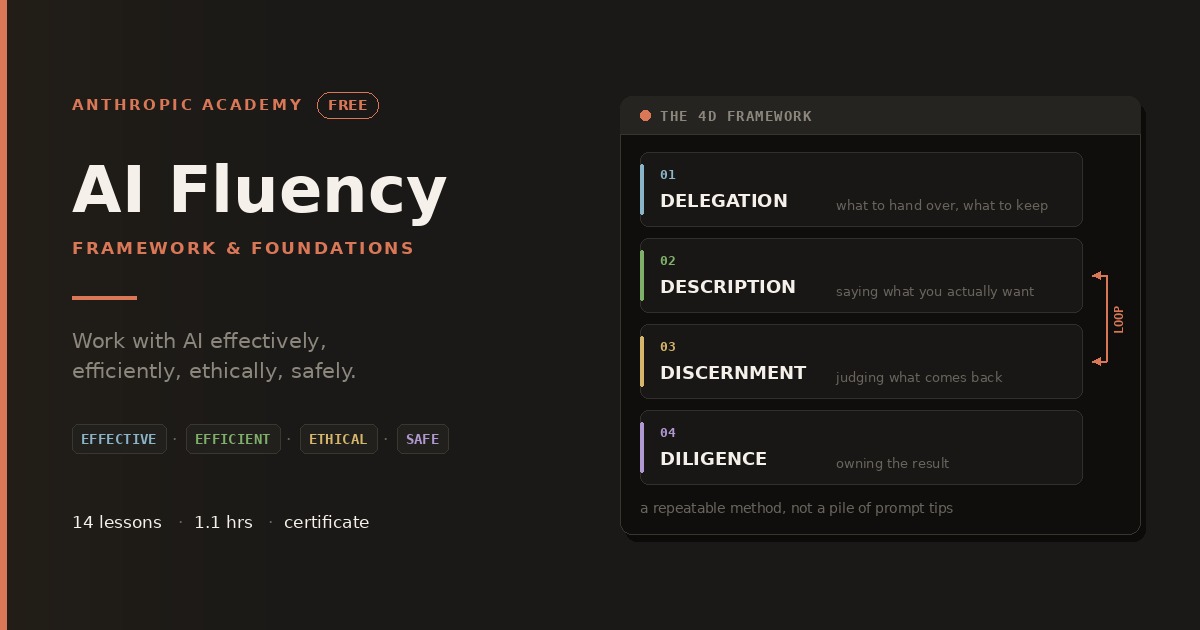
The 4D Framework
The spine of the course is four interconnected competencies, each beginning with D:
- Delegation is deciding what to hand to AI and what to keep for yourself
- Description is communicating what you want clearly enough to get it
- Discernment is evaluating what comes back with a critical eye
- Diligence is taking responsibility for how you use the output
The stated goal is collaboration that’s effective, efficient, ethical, and safe. Those four words each do real work. Effective means the results are actually good. Efficient means you got there without burning an hour on a five-minute task. Ethical means you considered the effects on other people. Safe means you understand where the system fails and planned for it.
One design decision matters here. The framework is deliberately model-agnostic, meant to hold up regardless of which AI tools emerge next. That’s a sensible bet for a course, since a curriculum built around one product’s current interface ages badly.
If you’ve read a lot of AI advice, you’ll notice this covers ground that usually gets skipped. Nearly every prompting guide is about Description alone. Almost nobody teaches Delegation, which is the decision that comes first and determines whether the rest was worth doing.
What’s in the two course sections?
AI Fundamentals & Framework
The first section builds the conceptual grounding. It establishes how generative AI systems actually work and why fluency matters for collaboration, then introduces the 4D Framework as a structure for human-AI interaction. It also covers the real capabilities and limitations of current AI.
That capabilities-and-limitations material is the practical payoff of this section. Knowing what AI genuinely does well, and where it reliably falls down, is what lets you make good delegation calls later. People who skip it end up either over-trusting output or refusing to use the tool for things it would handle easily. Both are expensive.
Anthropic frames the goal of this section as learning to approach AI tools strategically rather than reactively, which is a fair description of what separates fluent users from everyone else.
Practical AI Skills
The second section is hands-on, working through all four competencies.
Delegation covers dividing work between yourself and an AI system, and extends into project planning with AI. That extension matters, because a project isn’t one delegation decision made at the start. It’s a sequence of them. This is the part of the course I’d point to as the strongest justification for taking it, since delegation is where value gets created or wasted and it’s almost entirely missing from free advice online.
Description covers crafting effective prompts. This is the skill most people call “prompting,” treated here as one component of a larger practice rather than the whole game. The lessons go into specific techniques and the reasoning behind them, which matters, because techniques you understand transfer to new situations and techniques you memorized don’t.
Discernment covers evaluating outputs critically. Not just catching obvious errors, but recognizing output that’s plausible, well-written, confident, and subtly wrong. That’s the harder case and the more common one, and it gets more important as the models improve.
The description-discernment loop gets its own treatment, and rightly so. Working with AI isn’t one request and one answer. You describe, you evaluate, you refine the description based on what the evaluation taught you, and you go again. Most of the quality gets produced in that cycle. Beginners try to write one perfect prompt; fluent users iterate deliberately and know what to change each pass.
Diligence covers responsibility: verification, transparency about what AI contributed, and thinking about the effects of what you produce.
The section deliberately spans creative, business, and educational contexts rather than sticking to one field, which is what makes the course a reasonable recommendation for a general audience rather than just developers.
The AI diligence statement
The course page carries a full disclosure of how AI was used to build the course, and it’s worth reading as an example of the thing the course teaches.
The base content came from Dakan and Feller’s framework document and research notes, slide decks and lecture transcripts from their university courses and research talks, and practical material from Maggie Vo and Drew Bent. Claude 3.7 assisted the human authors with structural development, exercise design, and drafting, critiquing, editing, and rewriting. The human authors wrote, designed, edited, supplied the expertise and judgment, and made all final decisions. Everything AI-generated went through human validation and curation.
The statement closes by saying the disclosure is made in the spirit of transparency the framework itself advocates. A course about Diligence practicing Diligence on itself is a small thing, but it’s the kind of consistency that suggests the framework isn’t just language.
Who should take this course?
Anthropic says the course suits everyone from newcomers to seasoned practitioners, and the structure supports that claim in different ways for each group.
If you’re new to AI, you get a foundation instead of a pile of tips. You learn what these systems are, what they’re good and bad at, and a repeatable method. That beats collecting prompt tricks and hoping they generalize.
If you already use AI daily, the value is different. Your Description skills are probably fine, because that’s what everyone practices. The gaps are more likely in Delegation, which most people do by instinct, and Discernment, which most people do inconsistently. Having names for these skills is more useful than it sounds. You can’t deliberately improve at something you haven’t separated out and identified.
Practical details
The course is free. It runs on Skilljar, Anthropic’s learning platform, and registration only needs a Skilljar account, not an Anthropic one, though you’ll want access to an AI system to practice on as you go.
It’s self-paced with progress tracked, and at roughly 1.1 hours of video across 14 lessons it fits comfortably in an afternoon. The certificate comes after a final quiz rather than for simply reaching the end, which makes it worth marginally more as a credential.
Is it worth your time?
The honest case is that this course teaches the parts nobody else teaches.
There’s an enormous amount of free content about prompting. There’s almost nothing serious about deciding what to delegate in the first place, evaluating output you’re inclined to trust, or the loop between describing and judging that produces most of the quality. This course covers all of it, using a framework two professors built from research and then taught to actual university students.
The simpler argument: most people’s AI skills stopped improving a while ago, because there’s no obvious next step after “I got a result that seemed fine.” A framework gives you that next step. It tells you which skill to work on and what working on it looks like.
Fourteen lessons, about an hour of video, a certificate, and no cost.